Category Archives: Business

OnLive Cloud Gaming

At Fusion11 in Washington DC this week a presentation will set out The Positive Impact “Gamification” Will Have on IT Enterprises.

So what is Gamification?

Here is a 4 minute overview of the Gamified World which includes a description of Gamification.

OnLive cloud gaming comes to UK

This is gaming over the internet.

These new cloud based offerings will require a different type of service model.

Leave a comment

Filed under Business, Gaming

Learning-By-Doing and the 70:20:10 Rule

Human Resources professionals are using the

70:20:10 rule

to accelerate the development of their people. It is regarded as the best practice model for learning and development.

70% of learning is by doing on the job, so that individuals build a set of experiences through regular practice. It is also about expanding the role by taking on different opportunities.

20% of development should come from watching, observing Service Management Practice experts in the trenches and via peer collaboration.

Finally 10% of learning time and budget should be devoted to virtual or external learning, so that participants gain a foundation of skills.

Given this guidance approval of training budget spend to attend public ITIL or Service Management training conducts may not be as beneficial as attending Fusion11 or the itSMF UK conference where individuals can connect and share their war stories.  I would like to hear how effective the ServiceCamp courses are in the US.

Additionally a Lean Six Sigma black belt Master must have delivered a $1m benefit to achieve accreditation.  It would be interesting to hear your views on what the Gold Standard for an ITIL Expert or Master should be.

The ITIL Expert course may be unrealistic in managing people’s expectations because when you sit back and ponder; can one person really be an expert in all 5 core volumes?

Moreover is it sensible for a Service Desk Analyst to become an expert in all things related to Demand Management when they typically do not have these types of day-to-day conversations with their customers.

Qualifications are extremely important to dynamic young people who are working in Asian countries so they will strive to become ITIL Experts and Masters.

Gary Hamel says that “People must be willing to learn from the fringe because Innovation doesn’t come from the mainstream”.

This is What Good Looks Like encourages you to look on the WEB which as Hamel says is “the global operating system for Innovation”.

It will be interesting to see how fast we can create new knowledge content as a community through discussion, pooling our ideas and collaboration.

3 Comments

Filed under Business

Inside the ITIL Expert Tent

Section 6.10.3 Training of the Service Strategy core volume states the following:

Training in service management helps service providers to build and maintain their service management capability. Training needs must be matched to the requirements for competence and professional development.

The official ITIL qualification scheme enables organizations to develop the competence of their personnel through approved training courses. The courses help students to gain knowledge of ITIL best practices, develop their competencies and gain a recognized qualification.

In this item we will review the business benefit of gaining the ITIL Expert Qualification from a delegate’s point of view.
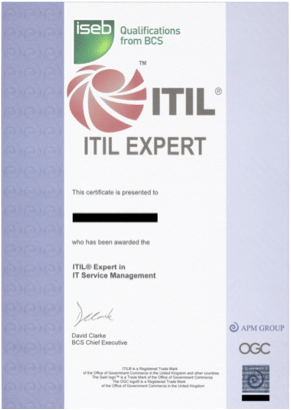
In late 2008 the organisation I was working for decided that they wanted to embrace the ITIL V3 standards and decided it would be good to have on the books a bona fide ITIL V3 Expert. I was approached to see if I was up for the task and accepted with little hesitation. I could not pass up the opportunity for a raft of recognised qualifications to add to my CV for free, and so my ITIL V3 journey began.

Between then and early 2011 I completed all five lifecycle courses and passed the Managing Across the Lifecycle exam to gain Expert status. So, how was my journey?

In terms of my learning experience there were, as with most things, positives and negatives. For all the Lifecycle Stage courses and the Managing Across the Lifecycle course I used the same training provider. The individuals delivering the training were on the whole very passionate and helpful.

I observed an area for improvement whilst attending a public course where delegates were joined by two new recruits into the Training Provider who were sitting in to observe how the presenter taught the same material as their previous employer. In principle this is a sound approach to take to ensure that the training delivery method is standardised however throughout the course there were multiple occasions where these individuals were challenging the learning style of the presenter as opposed to the content of the course.

This type of classroom based learning is always a good opportunity to network with similar minded professionals and gain an insight in to how other organisations approach the same challenges.  It also serves as a mechanism to obtain feedback on other people’s experiences of the same journey of discovery. One interesting observation I took from this was a reflection on the V3 qualification scheme as a whole.

There was a delegate on the Service Operations course who quite openly expressed frustration throughout the course as they had very recently undertaken the Operational Support & Analysis capability course. Although the ITIL Official Site describes the content overlap as ‘moderate’ the feedback from this delegate was that the content was c.90% overlap even to the extent that when it came to sit the mock exam paper 7 of the 8 questions for Service Operation were identical to the ones used on the previous mock for Operational Support & Analysis.

Overall I am pleased that I now have achieved ITIL Expert status but to what extent does the qualification actually help me be more impactful or productive?

Throughout my journey I have progressed my career within my own organisation but still do not envisage that I will be using all of the concepts that I learned.

A concern that I have is that I don’t think anyone would claim to be involved in the strategic decision making of an organisation as well as being concerned with the execution of operational processes such as Event Management and Access Management.

In voicing this concern I question whether I am in fact an ‘expert’ in ITIL at all. As the perceived Subject Matter Expert in Service Management Practices I get regular queries from internal stakeholders on “what good looks like”. Where these queries are not directly related to my primary area of work I find myself having to refer to the books to answer the questions.

In conclusion, the positive to take away from this journey is that I now have a set of recognised industry relevant qualifications on my CV. Although this gives me a snese of personal achievement and may open doors for me in the future I did not end my journey with an overwhelming sense of enrichment obtained from my own learning experience.

Thanks to my colleague CF for sharing his insight.

1 Comment

Filed under Business

Service Strategy

[youtube http://youtu.be/djS4JBIp8co]

At 06.27 the Product Manager role has been removed. It would be interesting to ask Michael Nieves & Majid Iqbal for their view on this deletion.

At 08.40 Customer Agreement Portfolio is mentioned on page 178, section 4.2.4.8 and is a contract repository.

At 09.50 Business Relationship Manager is a major and important addition. BRM was in version 2, but not in version 3. BRM is also in ISO/IEC 20000.

At 12.45 Service Strategy should be mandatory reading.

BRM is a major and important edition

I definitely agree that this is an important topic and would like to amplify the following points.

ITIL 2011 Edition says – BRM is the primary process for strategic communication with Customers including Application Development.

In my experience Project Investment decisions are typically made by a different set of Business Stakeholders who are not engaged in day-to-day service conversations.

In the UK the Global/Retail Banks have addressed the overlap between the BRM/Account Manager/Service Manager responsibilities by calling their customer facing individual a Business Partner who is dedicated to real strategic dialogue with their stakeholders.  Contact Jim Ditmore CIO @ Barclays; Stephen Norman CIO @ RBS or Darryl West CIO @ LBG.

ISEB the Information Systems Examination Board also has a Specialist Certificate in Business Relationship Management Syllabus.


Ivanka Menken knows what good looks like she has authored a BRM Workbook and Toolkit.


Business Relationship Management – too much for one person?

Andrew Horne is global head of research at the CIO Executive Board, program of the Corporate Executive Board.

The task requires a range of skills that are hard to find in one person as described in the following article

Leave a comment

Filed under Business

ITIL 2011 Edition

Introduction to ITIL 2011 Edition

[youtube http://youtu.be/9R9L3yPYAjI]

At 04.47 Vernon states the number of ITIL experts

At 08.03 The reader will find the service strategy core volume quite different

At 13.00 is the overview of the service strategy volume

At 14.19 Business Relationship Management new Full Process

ITIL 2011 Lifecycle Poster

A free download of the poster can be found HERE

Leave a comment

Filed under Business