Category Archives: Business

Gartner research note sets out how the Cloud Services Brokerage market will grow

Cloud Services Brokerages Challenge Traditional IT Service Providers for Cloud Services Delivery

There is confusion about why the term “cloud services brokerage” is needed when traditional IT services firms already embrace an array of cloud services. We examine why we need the term “cloud services brokerage” in cloud computing and the broader traditional IT services market.

Tiffani Bova | Daryl C. Plummer

Published: 1 May 2012 ID:G00233235

Key Finding

  • Cloud services brokerage (CSB) defines a role and key value propositions for new cloud-enabled IT services offerings that the market is demanding.
  • CSBs have cloud at the center of their solutions and business models, whereas traditional IT services providers are transforming and transitioning their portfolios to include cloud services. CSBs won’t likely offer traditional application and infrastructure services without the presence of at least one cloud service.
  • Many traditional IT services providers are struggling to define their path in cloud services, as they face challenges in delivery, growth and profitability, without undoing their core business, which has been immensely successful and profitable.
  • CSBs do not eliminate the roles that IT services providers have played and will continue to play in the market. Instead, CSBs are focused on providing seamless and flexible access to multiple cloud services (many of which may reduce costs or complexity around consuming multiple cloud services). CSBs will introduce more competition and place more pressure on existing, and sometimes incumbent, providers to reduce scope, scale and complexity in their offerings.
  • Understanding the value that a CSB provides by consuming multiple cloud services gives internal IT leaders who are driving cloud adoption a focused way to understand what they should be focused on. Also, it gives traditional IT services providers guidance on which IT service roles will be most affected by cloud.
  • Many traditional IT services providers are pursuing cloud services as new offerings; however, these are not the same roles that will drive the growth of a composite CSB market. A CSB plays a specific role within the cloud services value chain and is not required in all instances.

Recommendations

  • Sourcing, vendor managers and CIOs: If cloud services are the center of a desired solution, then use the CSB select/evaluation criteria versus the traditional IT services criteria (see “Essential Provider Selection Criteria to Use When Outsourcing the CSB Role”), because the CSB attributes address a different set of requirements.
  • When planning your overall cloud strategy, taking into consideration the most effective and efficient acquisition and support model should include the option of leveraging a CSB, especially if you plan to consume more than three different cloud services.
  • Develop internal IT skills that are focused on business process management and how a cohesive hybrid IT environment can deliver expected business results.

Analysis

CSB is a term that describes the market, model and role that support the intermediation between cloud services and cloud consumers. This intermediation, and a definition of the term, is described in detail in “Cloud Services Brokerage is Dominated by Three Primary Roles.” Also brokerage, as a business component, emerges whenever a service provider-service consumer model is established (see “The Role of CSB in the Cloud Services Value Chain”). Stock brokers, real-estate brokers, travel brokers and third-party advisory/intermediary firms represent simple and well-known examples of a brokerage. The existence of brokerage models is not in question. However, the issue arises in the IT sector, when trying to compare the brokerage models with traditional IT service models. This research examines the reasons that “brokerage” as a term and a concept in cloud computing is necessary and useful. It will allow us to distinguish when traditional IT service language and approaches are good enough versus when cloud services brokerage language is more appropriate (see Note 2). This research offers traditional IT services providers and end-user organizations guidance on how new CSBs will position themselves in the market to differentiate from the traditional IT services provider.

IT Services Were Here First

One complaint that brokerage naysayers advocate is that the language of brokerage (e.g., aggregation brokerage, integration brokerage and customization brokerage) is already covered by traditional roles such as technology aggregator, solutions aggregator, system integrator (SI), independent software vendor (ISV) or distributor. They argue that there is no need for new terminology to describe what is already being done by these providers. Some traditional aggregators even go so far as to say they do not like the term “broker” because it minimizes their value into something that can be quickly commoditized. We respectfully suggest that traditional language is not always appropriate when applied to cloud-based solutions (see Note 1). The differences in the cloud model identify significant differences in how aggregation, integration and so forth must be done to deliver on the cloud computing value proposition of agility, efficiency, new capabilities and reduced cost. Traditional IT services providers often have access to, and can make direct changes to, specific technologies, which is not necessarily true in cloud delivered services (such as software as a service [SaaS], platform as a service, infrastructure as a service, and business process as a service).

Because cloud providers do not generally allow a third party to have general access to all back-end systems, code, technologies, or even visibility into how the service is built or architected, the ability to have (implementation or integration) control, is severely limited. This represents a major difference, for example, in how one must approach integration in the cloud versus on-premises, custom-built implementations.

We Must Use More-Effective Terms When Describing Changes to Markets

In the cloud brokerage world, the new terminology is intended specifically to introduce the concept of three or more independent parties (provider, consumer and broker) working together, where no one of them has complete control over the actions of the others. Brokers intermediate rather than control; Traditional SIs, ISVs and aggregators control more often than intermediate. In the cloud, intermediation is more about coordinating the inputs and outputs of multiple services, rather than about controlling how their technology is implemented. This highlights the core difference. Using the traditional IT services language can imply that a certain level of technology control or assurance is available in the cloud when it is not. Neither the integration brokerage nor the consumer controls the technologies or the business workings of the original cloud service providers whose services are being integrated. In this way, cloud brokerages are responsible and must manage the risk of failure, low service quality, inadequate security assurance, and liability between providers and consumers — all through a relationship in which the brokerage is the customers’ single point-of-contact for multiple cloud services, even where they have little control over certain outcomes.

However, at no point does Gartner suggest that cloud services brokerage should replace traditional IT services or minimize them. Instead, we offer CSB as a set of roles (within a composite CSB market and using CSB models) that can be adopted by traditional IT services companies whenever they need to add additional value to cloud services on behalf of their customers (such as hybrid cloud solutions, or integrated cloud services). For example, the SI role and the CSB aggregation role are not the same, but they represent complementary approaches to solving customer problems in managing products or services from multiple providers. A CSB must interact with at least one or more cloud service, otherwise the term is inappropriate and the CSB would continue to be considered a traditional IT services provider because it was providing integration services.

Also, other differences are worth noting. Gartner has identified six key differences that make CSB something more and less than traditional IT services.

No. 1: The Buyers Can Be Different

Cloud brokerages will have buyers ranging from individual consumers to small or midsize businesses (SMBs) and large enterprises. This range of buyers is seldom served by traditional IT services providers exclusively.

No. 2: The Cloud Brokerage Cannot Modify the Actual Service Implementation or Own the Technology

In traditional IT service scenarios, the SI usually has access to, and sometimes complete control over, the technology within the provider solutions that they are delivering. The potential removal of that control places different burdens on the integration brokerage, which has to integrate or aggregate services it has little ability to change.

No. 3: The Technology Used for Integration, Customization and Management Can Be Different as Can the Integration Scenarios

CSBs may use different technology than the traditional system integrators employ to deliver solutions to their customers. These technologies not only require different skills to use, they apply to different kinds of integration scenarios. Federation, API management, governance (for policy management and enforcement), and offline asynchronous access are among the simple differences. Cloud brokerage technologies for integration and governance in shared multitenant environments account for more than half of the difficulty in integrating cloud services, as opposed to on-premises technologies.

No. 4: The Contract Is Managed Differently

Although the relationship management side of purchasing cloud services will remain relatively the same as traditional IT purchases, the CSB model will lessen the need for high-touch, high-trust relationship-intensive models when it comes to contracting with all the individual cloud service providers that customers choose to work with.

Cloud contracts will typically involve multiple companies that are given assurances only through the contract that may rely on outcomes to manage. In other words, a cloud integration brokerage must integrate services where the only guarantee of performance or availability is through the established SLA agreed on in the customer contract or the brokerage agreement.

Although this happens at times in traditional technology integration, in the cloud, the added restrictions makes it much more difficult to get detailed information about the system underlying the services being integrated, which can cause significant risk for CSBs.

Establishing who is to blame for a problem is an extraordinary challenge for customers and brokerages alike. It is critical that CSBs keep their focus on demand/experience fulfillment, and responsiveness to incidents/issues to ensure that the relationship is consistently supported by a positive experience.

No. 5: The Channel for Cloud Brokerage May Be Widely Different Than Those Established for Traditional System Integrators

Selling through and with other channels adds a layer of complexity to the CSB role. Determining the best way to market will drive increased adoption. However, in the cloud service value chain, the suppliers and distributors will often be new entrants to the market with relatively unknown capabilities and brands.

No. 6: There Are New Cloud Specialists

This may be the most important reason for having new terminology. New cloud specialists that do brokerage, integration, customization and aggregation do not necessarily come from the traditional IT services world and do not associate themselves with it (see “Who’s Who in Cloud Service Brokerage”). They approach customers with different marketing messages. They have different technical and business-related skills, establish new value propositions, generally have well-established partner ecosystems dominated by third-party cloud-native IT providers, demand new types of relationships (with providers and customers) based on cloud-centric innovation and business models, and use new technologies and integration scenarios to provide cloud-based solutions.

The Impact

Cloud computing is moving fast (“Forecast: Public Cloud Services, Worldwide and Regions, Industry Sectors, 2010-2015, 2011 Update”). The influx of new cloud specialists is helping in the adoption, however there is still a significant skill gap for providers that have cloud experience and internal domain expertise for implementing and integrating multiple cloud services (see “Cloud Adoption at Risk Without Big Channel Investments”) broadly across the market.

Gartner predicts that the number of CSBs that will go for scale and large market reach will be in the hundreds worldwide, and include communications services providers, IT wholesale distributors, retailers and large direct market resellers (to name a few) because they have the existing customer relationships with a majority of the SMB market and are pushing for greater relevance in cloud. This is not to say that others won’t become CSBs, which are more locally focused on vertical markets or segments and keep their offerings to a tightly managed set of services.

Companies taking on the CSB role are expected to handle certain scenarios that would previously have primarily been the domain only he traditional IT services providers. This suggests that there is some urgency to either capture market share in the cloud for those original providers before new companies do it, or that traditional providers will likely acquire the new cloud specialists that are brokerages, to fill out their cloud portfolio. One other option is that companies need to do it before the original cloud service providers acquire new cloud specialists to fill out their new cloud channel ecosystem.

Conclusion

The relationship between CSBs and other types of IT services sourcing and delivery models can be confusing. In particular, the question is often asked: What is the difference between CSBs and traditional IT services offerings?

For clients who have followed Gartner’s cloud research, certainly both terms include similar concepts, since brokerage deals with aggregation, integration, custom development, or even governance/management of cloud services are also attributes of traditional IT services providers’ offerings.

The answer for IT providers and buyers of cloud services lies in examining what is different enough about cloud computing to warrant the CSB term. Service providers need a mental framework for deciding how to migrate services to the cloud, while consumers of cloud services would benefit from the same mental framework to be used in helping them decide how to pick the right cloud brokerage providers.

Please not that the above text is not a complete version of the research note most of the six key differences have been edited.

Cloud Service Model

Key difference No.4 – The Contract Is Managed Differently

The traditional approach to managed services is to create a thin retained layer or carve out responsibility to the procurement capability for oversight and governance of the Service Provider.

With the Cloud new Service Delivery models will evolve and the role of the Cloud Service Broker will be to stitch the end-to-end service value chain together.  The complication with these new ways of working is that the CSB has limited control of the service provided to the Business.

I do not agree with Tiffani / Daryl that the answer lies in a Service Level Agreement with defined penalties.  This will not enable the CSB to provide predictable service levels.

What is required is a refresh of the way that Service Management Practices will enable the Business, Retained IT and the CSB to review Business Outcomes instead of service metrics and process measures.

For example – the cloud enables elasticity and can provide capacity on demand to process  a significant volume of invoices during peak periods where previously they may have been stuck in the system or a backlog built up.

For me, a Cloud Service Model means that utility / warranty (defined in the ITIL 2011 Edition Service Strategy core volume)  is delivered from a “Black Box” so rather than focus on managing the CSB the Service Management role will need to become a hybrid manager and focus on enabling Business Change.

Most service organisations already have a Business Relationship Manager role, however these individuals will need to shift their attention away from just Portfolio and Demand Management more towards presenting options to the Business that demonstrate how the Cloud platform can bring new solutions to the table.

Innovative Cloud Solutions

The cloud enables you to think beyond the traditional

You have to make cloud transformative for your Business

If you’re not thinking out of the box you are not really thinking about the cloud in the right way

 You are not doing the things that the cloud makes possible

1 Comment

Filed under Business

Cloud Sourcing, Cloud Brokerage and Hyper-Hybrid Clouds

Cloud Sourcing

Frances Karamouzis and David Mitchell Smith

During the next few years, market dynamics will determine whether cloud sourcing will be the demise of traditional outsourcing, if it will lead to the convergence of services and products currently marketed “as a service,” or if it will result in next-generation outsourcing.

Clients now have more choice, that choice is to turn away from internal IT and look at external vendors that can do all of those services at once

Get “SLAs with teeth” those that have business implications


How Cloud Brokers Will Differentiate

Gartner VP Tiffani Bova discusses how VARs, MSPs and technology consultants can become cloud brokers working within cloud aggregator services.

How many of you in the audience feel that you have being delivering Cloud for years?

How many of you today can do usage based billing?

It isn’t about the PC it’s about the Personal Cloud

I

Besol named ‘Cool Vendor’ in

Cloud Services Brokerage

Besol, the leading provider of next generation multi-cloud management platforms for private and public clouds, today announced that the world’s leading IT analyst firm, Gartner Inc., has selected the company as a Cool Vendor in Gartner’s “Cool Vendors in Cloud Services Brokerage Enablers, 2012” report published on 12 April 2012 by Tiffani Bova, Daryl C. Plummer, et al.

According to the Gartner report Key Findings, “The cloud services brokerage (CSB) is emerging, and first-mover advantage will be key to gaining awareness and share. CSBs are challenged to continuously build or buy the capabilities required to compete in the three CSB roles: aggregation, integration and customization”

“We in Besol believe being chosen as Gartner Cool Vendor is as a testament to the dedication, hard work and focus on innovation of our team” said Javier Perez-Griffo, Co-Founder and CEO of Besol. “The Tapp platform from Besol allows users to manage their cloud infrastructures independently of their cloud provider, but more importantly, enterprises can manage both their public and private clouds from a centralized point.”

Perez-Griffo continues “Cloud services are no longer restrained to large enterprises or IT-savvy organizations. Through our platform, SMBs of all kinds are now able to ‘tapp into’ the cloud and deploy and manage their infrastructures seamlessly, in a completely new user-friendly experience.”

Hyper-hybrid Clouds

Chris Weitz – Deloitte

Today, hyper-hybrid clouds are an advanced form of cloud services in the early stages of adoption, but the approach is rapidly becoming the norm for cloud services architecture.

A hybrid cloud is a cloud that works across different environments where you have services from vendor clouds working directly with clouds inside of an organization, thus forming a hybrid cloud.

Hyper-hybrid clouds are the multiplication of numerous hybrid clouds working together to serve an organization. The hype curve for cloud computing is at an all-time high, for pretty good reasons. Cloud computing can help increase agility, decrease costs and improve service delivery capabilities — and it can happen fast.

Tiffani Bova – has coined the term “born in the cloud”,  For me this is where new capabilities are forming on the cloud platform so that a different approach is required to manage the increased complexity of hyper-hybrid clouds.

Cloud Service Brokers add value by managing one or more cloud service on behalf of the service’s recipients.  Gartner says that cloud service brokers represent the single largest revenue growth opportunity in cloud computing through 2015, emphasizing that without cloud brokerage the cloud industry cannot survive.

I say that clients will need to design and implement Cloud Service Management practices [CloudSM] to govern the relationship with their cloud service brokers and external providers.

Services configured from Hyper-Hybrid clouds will set new delivery challenges for Next Generation Service Management CloudSM to overcome.

The guidance provided by the ITIL 2011 Edition and COBIT5 framework does not help define CloudSM practices required to address the dislocation of company compute assets which previously were on-premise and have now become “Place Less” being delivered from anywhere in the Hyper-hybrid Cloud. 

So what criteria do you apply in sourcing your Cloud Service Provider?

Do you need to engage a Cloud Service Broker?

Should you jump to Hyper-Hybrid clouds directly or be more risk averse?

I can only think of the classic consultant response “it depends”

Leave a comment

Filed under Business

Will it be acceptable to wear Google glasses in the workplace?

“On June 27th Sergey Brin, one of the company’s co-founders, revealed the next stage of Project Glass, its effort to create wireless-connected glasses that allow their wearers to do a host of things, including receiving and responding to messages, and taking and sharing photos and videos.”

Economist – 30th June Edition – LINK

Google Glass Explorer Edition

Google’s Sergey Brin reveals video-capturing, augmented reality glasses at Google I/O in San Francisco.

we don’t want technology to get in the way

we want to empower people to use technology naturally

Google Glasses Demo

The Google Glass Explorer Edition will sell to software developers for $1,500 and ship in early 2013.

As you can see from the demo with augmented reality you can look at a subject and a wealth of helpful data will be overlaid.

As always success will be predicated on the ability of application software to analyse data and help ensure that you have the right information at the point of need. 

For me Google Glass combines the best of the three major initiatives for any large organisation, namely Mobility, Analytics and Big Data.  Glass is a completely new mobile platform that will enable access to cloud based personal or company information that is tailored to individual needs.

I envisage that in 2013 Gartner will publish their peak of inflated expectations for Wearable Computing.  This new Hype Cycle will spike interest in wearable computer glasses. 

Just like smartphones and tablets the price of wearable computer glasses will be driven down over time.  These glasses will become the must have fashion item for Q1 2014 as rich apps [systems of engagement] are made available, and the price for a pair of glasses is more affordable.

I believe that the key difference between smartphones, tablets and Google Glasses is that you no longer need to look down at your device.  Glass allows the individual to keep looking up and stay engaged in the moment. [Look Up not Down]     

Having reluctantly accepted the need to allow staff to bring their own devices into the workplace the CIO will need to have policies in place to deal with the new challenges that wearable computing and augmented reality present.

With Google Glasses the individual has ubiquitous access to audio, video and data that is enriched by augmented reality. 

Controlling access to company information assets will be a security concern for most CIOs and will make it high on their list of top 10 issues to deal with over the next 18 months.

Leave a comment

Filed under Business

Cloud Computing Economics

In my 27th May post I responded to a thought provoking article by Bernard Golden stating that “CIOs are not Business Leaders”.

We exchanged details and I had the good fortune to meet with Bernard this week in London.

Bernard is one of the “Rock Stars” of Cloud Computing and has recently joined enStratus as its new Vice President of Enterprise Solutions.

“In this new role, Bernard will help enStratus customers leverage the cloud and build best-practice operations based on the enStratus cloud management platform. Bernard brings vast experience working with CIOs around the world to incorporate new IT technologies and meet their business goals”.

We discussed various Cloud topics and I would like to focus on two themes.

Cloud Economics

Mark Teter, CTO at Advanced Systems Group, discusses the economics of cloud computing today.

Cloud Providers have a Chinese Menu of charges

What is your Total Cost of Assets?

Substituting a one time Capex model for a Re-ocurring Opex model

Divorce is expensive from a Cloud Provider

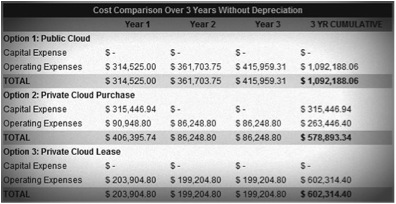
“Recently, ASG conducted a detailed financial analysis of three cloud computing solutions:

1) public cloud from Amazon EC2;

2) purchased private cloud infrastructure; and,

3) a leased private cloud infrastructure. Here’s what we found:

Based on our analysis, a private cloud computing solution whether leased or purchased would seem the way to go. In addition to the financial benefits, we feel that there’s a propensity for additional flexibility and greater uptime.

This analysis shows a $513,295 cumulative cost savings over three years for the private cloud purchase versus the public cloud option. The private cloud lease saved $489,874 versus the public cloud option over the same three years”.

The Truth About Cloud Economics

By Drue Reeves and Daryl Plummer of Gartner – LINK to full HBR article

“For companies, cloud computing’s new economic model stands in stark contrast to the traditional economic model of IT where we buy technology from a vendor as a capital investment and continue to invest in maintaining and servicing it over time. Traditionally, much of the money allocated to technology has been locked away in capital expense allocations used for buying physical goods. However, cloud services are just that, a service, and require reallocating money to operating expense budgets”.

New Delivery Model

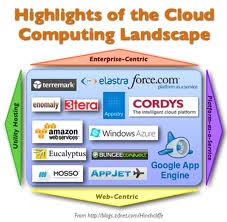
Verizon offers customers guarantees about how fast data will travel between one cloud and the other. Verizon bought Terremark in 2011 to competes with providers such as Savvis or Rackspace.  This short video takes a creative approach to exploring how Verizon and its Terremark IT services delivery arm are fundamentally changing how businesses and consumers will access content.

The Cloud is Democratizing Technology

The Network is going to evolve into an IT Platform

Must be able to Deliver Metered Billed It Services

So the Cloud Computing Economic model is compelling:

  • No initial capital spend required
  • A flexible TCO model for service provision can be lower (typically in the short term)
  • Good way to align and scale “technical capacity” with “business demand” (e.g. Xmas trading, Summer trading, Financial Period end)

Senior Business Stakeholders are investigating how, when and what to migrate to the Cloud without compromising security and regulatory requirements.

The Business needs to have transparency in order to evaluate whether it is buying the right cloud services and managing them in the right way.

There are many companies providing advisory services however the Vendors tend to sell the benefits of their cloud enterprise solutions [e.g. IBM SmartCloud, Citrix CloudStack, SAVVIS Symphony] and typically ignore the radical set of new people and process challenges.

CloudSM

As a Service Management Practitioner I believe there is a gap in the market which I am calling  CloudSM – Cloud Service Management is typically a managed service or a dedicated on-premise private solution.

The Cloud Service Management provider is accountable for end-to-end governance and delivers key process capabilities including orchestration, service provisioning, automated workflows, monitoring and metering.

External managed Cloud Service Providers have the people know how and mature processes to be more compliant than internal IT shops.  In addition they will definitely deliver CAPEX and OPEX savings that can be re-invested in enabling Business change.  

Welcome to the new world of Cloud Service Management that is required to manage the New Delivery Models.

Leave a comment

Filed under Business

Is Reshoring the way to increased World Competitiveness?

Professor Stéphane Garelli is my favourite Economist. He is an authority on World Competitiveness and also the director of the IMD’s World Competitiveness Center: his research focuses particularly on how nations and enterprises compete on international markets

On 31st May IMD announced the findings of its annual World Competitiveness Yearbook (WCY). The WCY rankings measure how well countries manage their economic and human resources to increase their prosperity.

Here are the summary results for the UK and the US.

2012 Ranking


UK

US

 Overall Competitiveness

18

2

 Economic Performance

19

1

 Government Efficiency

23

22

 Business Efficiency

22

11

 Infrastructure

15

1

Report Finding 28. From Service to Re-industrialization

“Service competitiveness and the ability to integrate and manage a global business model were at the core of the competitiveness of Europe and the US. However both regions have lost 20% of their industry in 20 years, thus creating a higher level of permanent unemployment.

Companies reassess extreme outsourcing and delocalization. “Reshoring” and re-industrialization become an economic and political priority. There is no competitiveness without a sound manufacturing base”.

Harry Moser is the founder of the Reshoring Initiative


So like Manufacturing jobs will Information Technology Outsourcing and Business Process Outsourcing jobs reshore?

Outsourcing Service Providers have been landing staff in the US and the UK for years.  What has changed is that the Visa Entry Criteria has been turned up a few notches on the dial.  Individuals must have niche skills which are in short supply.  This does not explain the hundreds of staff at one Retail Bank who are providing commodity Testing Service onshore.

Stephanie Moore is a Vice President and Principal Analyst at Forrester Research

She serves Sourcing and Vendor Management Professionals.

“Forrester clients should act now to help solve this problem. Encourage your vendors to hire local for local positions and invest in training those locals. This will solve your context and requirements problems, your visa problems and the improvement in productivity will make up for any price increase related to local labor”.

Reshoring of ITO and BPO jobs is already a major issue in the US presidential election debate.  Political will is setting the agenda for increased investment in job creation.  

The Indian Pure Plays, IBM, Accenture etc. will all have to invest in more positions being based locally at client site.

At the end of March 2012, the BBC reported that “the UK economy will contract in the first three months of 2012, taking the country back into recession, according to the Organisation for Economic Co-operation and Development (OECD)”.

Given the UK Economy reliance on Services jobs it appears that we are in need of a shot in the arm to kick start growth. 

Reshoring technology and knowledge worker jobs back to the UK may not make a material difference to the position of the UK in the WCY Ranking for 2013 but it feels like the right thing to do.  

Investing in Training and Career Development of graduates with intellectual firepower must be more important than chasing alpha / mammon.

Leave a comment

Filed under Business

Gartner Survey Shows Why Projects Fail

Analyst : Lars Mieritz

Published: 1 June 2012 ID:G00231952

A recent Gartner user survey shows that, while large IT projects are more likely to fail than small projects, around half of all project failures, irrespective of project size, were put down to functionality issues and substantial delays.

Key Findings

  • Runaway budget costs are behind one-quarter of project failures for projects with budgets greater than $350,000.
  • Small is beautiful — or at least small projects are easier to manage and execute. The failure rate of large IT projects with budgets exceeding $1 million was found to be almost 50% higher than for projects with budgets below $350,000.

Recommendations

  • To optimize success, look for ways to limit the size, complexity and duration of individual projects, and ensure funding has been committed.
  • Stay on top of costs, especially for the largest projects. Ensure that there are the appropriate mechanisms in place to identify budget variances and/or overruns early. Regularly review how cost estimation is done to understand how accurate and effective your approaches are, and pursue improvement opportunities.
  • Keep the schedule realistic. Many large projects fail because business conditions keep changing after the project scope has been set, leaving a significant disconnect between the agreed-on scope and budget versus what the business will require and pay for by the time the project is delivered.
  • Invest in truly capturing and understanding the business expectations and functionality sought from the project, and ensure that there is initial, adequate allocated funding, as well as good processes in place for revisiting the expectations and required funding at multiple points during the project.
  • Increase the frequency of project status and review meetings, as well as ongoing confirmation of the project’s alignment with business strategy — with an eye toward identifying and cancelling projects at the earliest possible stage that no longer meet company needs. 

Survey Objective

The survey was conducted to provide insights into IT project performance in organizations across North America, France, Germany and the United Kingdom.

Data Insights

Survey data is a useful tool for heads of project management offices (PMOs) to gain a broad perspective on the major causes of IT project failures and to assist in the challenge of identifying, building, and developing the skills and staff required for highly effective project and program leadership.

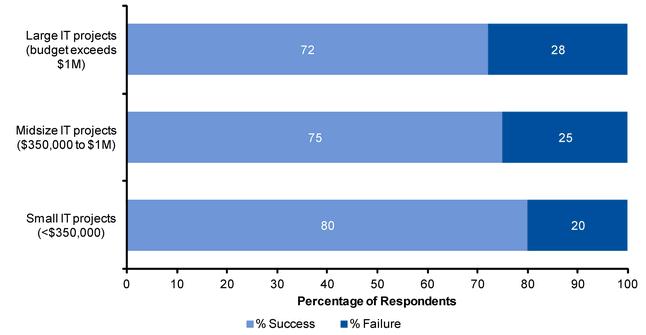
This research explores the survey results with regard to causes of project failure across three project sizes and provides a tangible reminder for all project and portfolio management (PPM) professionals not to lose sight of the trade-offs sometimes required for delivering projects on time, on budget and with the agreed functionality.1 For the purposes of this survey, small, midsize and large projects were defined as follows (see Figure 1):

  • A small project was one with a budget of less than $350,000.
  • A midsize project was one with a budget of $350,000 to $1 million.
  • A large project was one with a budget that exceeded $1 million.

Figure 1. Distribution of Success and Failure Across Project Sizes

 Source: Gartner (June 2012)

Figure 1 illustrates the distribution of success and failure across project size. The respondents were asked to indicate the percentage of their organization’s IT projects over the past two years that were deemed a success or failure by the business.

In analyzing the collective responses of some 150 participants in the 2011 Gartner five-country survey, the failure rate of IT projects with budgets exceeding $1 million was found to be almost 50% higher than for projects with budgets below $350,000.2 At 25% and 28% respectively, the failure rates of midsize and large projects are similar, and in both cases, nearly one-third higher than the 20% failure rate observed for small projects (with budgets below $350,000). Overall, the results of this survey are consistent with what we have observed when we have polled this question previously, and we are seeing a pattern emerging where small IT projects experience a one-third lower failure rate than large projects 3

Many small brooks make a great river. The survey results give a clear indication that, by ensuring that projects are kept small, and as a rule of thumb, not exceeding six months in duration, a much lower failure rate can be achieved. As such, setting clear criteria around limiting project size will be a hallmark for successful PMOs, and the guiding principle revolves around establishing projects whose scopes and functionality can indeed be delivered in the time frame and, thus, maintaining a clear focus of the endpoint.

Rather than taking on large, expensive and lengthy projects, it will be more prudent to view them as programs consisting of a series of small projects, each delivering its piece of the overall initiative. This will also enable the use of regular program oversight reviews to ensure that the big picture is maintained and to rapidly reassess and recalibrate should any of the individual efforts get off track.3

No matter what the reason, no one likes failures, so in seeking to understand the causes behind the project failures, Gartner asked the respondents to distribute the projects that were deemed to have failed in their organizations over the past two years across six frequently mentioned reasons or causes of project failure:

  • Functionality issues
  • Substantially late
  • Quality issues
  • High cost variance
  • Canceled after launch
  • Rejected or not implemented for other reasons

Figure 2 explores the project failures shown in Figure 1, and illustrates the percentage of failures that respondents allocated to these six typical causes of IT application project failure (see Note 1 for project failure definitions).

Figure 2. Why Projects Fail

 Source: Gartner (June 2012)

It is not entirely surprising to see that the challenges of bringing projects in on time, on budget and with the agreed functionality are mentioned by two-thirds of the respondents as causes of project failure, because this is largely in line with previous observations.4 However, that fact underlines the ongoing nature of these three challenges in the sense that, no matter where you stop and take a snapshot, these three are likely to appear. The key is not to be complacent (we are not the only ones with projects running over), and take steps to understand the particular circumstances in the enterprises so that the right mix of processes, people, tools and skills can be developed or put in place.

Figure 2 also highlights the improvement opportunities that can be achieved simply from improved communications, in the sense that nearly half the projects fial for not doing what they need to do (functionality) or doing it too late to be valuable (late). This hints at project planners not asking the right questions, such as “When is late too late?” or “What scope would you give up to have something delivered sooner?” or reassessing functionality needs with enough regularity that no gap is allowed to develop. Project planners need to be aware of and address changes in the environment, and understand that cost, scope and schedule are not weighted equally. By maintaining close ties to sponsors and stakeholders, and being upfront regarding the trade-offs between functionality scope and schedule, expectations can be recalibrated on an ongoing basis, thus improving success rates.

For organizations at the lower levels of PPM maturity, any effort toward improving scheduling, cost estimation and functionality will yield significant results. For organizations at the higher levels of maturity, we recommend broadening the suite of performance metrics that are used to provide deeper insight into the factors that might be driving the rather persistent greater than 20% failure rate we’ve seen over the years.

Methodology

Gartner conducted a research study in October 2011 to examine current performance of IT projects in North America (the U.S. and Canada), France, Germany and the United Kingdom (see Figure 3).

Figure 3. Geographic Distribution of Respondents

 Source: Gartner (June 2012)

In all, 154 organizations with at least one PMO or related office were qualified and interviewed via a Web-based survey. All respondents were required to manage or work within their organization’s project management function. The resulting sample consists of organizations across various industry segments (see Figure 4) with $500 million or more (see Figure 5) in annual revenue.

Figure 4. Distribution of Respondents by Industry

Source: Gartner (June 2012)

These findings and recommendations from the Gartner survey are in line with conventional wisdom.  

So what can we do differently to help ensure project success?  

The people side of any change programme must be addressed in order to secure success.  

In addition, provide regular feedback to the customer, for example by adopting Agile SCRUM principles of iterative development or implementing new Systems of Engagement practices.  

One fresh area to be considered is Cloud based Development and Deployment.

Introducing Enterprise Cloud Development:

the next evolution in managing modern software development across the enterprise.

[youtube http://youtu.be/7szMYT9LkvQ]

Three Industry Innovations have emerged  – Agile Software Development + DevOps + Hybrid Cloud Development & Deployment

Five Step Blueprint for Embracing Enterprise Cloud Development Blueprint

78 Comments

Filed under Business

Forrester’s “Forrsights”

It is important to keep up with the latest research and predictions from the leading analysts.  With this in mind I have selected three contributions from Forrester.

  • There is a growing expectation gap between IT and the consumer
  • Key forces and challenges are driving the need to Transform IT 
  • The need for speed is accelerating – and IT isn’t keeping up

Matt Brown – Vice President serving CIOs

What we are witnessing is a growing expectations gap where consumer technology markets are moving so fast that IT is having a hard time keeping up.

Work is getting separated from place with more and more remote work.

Eveline Oehrlich (Hubbert) – BrightTalk webinar 31 May

+1 617-613-8803  –  eoehrlich@forrester.com  –  Blog: blogs.forrester.com/eveline_oehrlich

 Transform Your IT Organization With Process-Based Service Management

LINK to Webinar.  It is straightforward to register

My thanks to Eveline for sharing her presentation materials with me

There are three sets of forces shaping business demand

  1. Business Ready, Self Service Technologies are on the rise
  2. The number of empowered self-sufficient, tech-savvy workers is rising
  3. The Business Environment will be radically more complex

Key Challenges

  • An increasing IT capability gap
  • Technology tribes
  • Engineer-to-order
  • Lack of control with what processes and tools they work
  • Pace of change/complexity
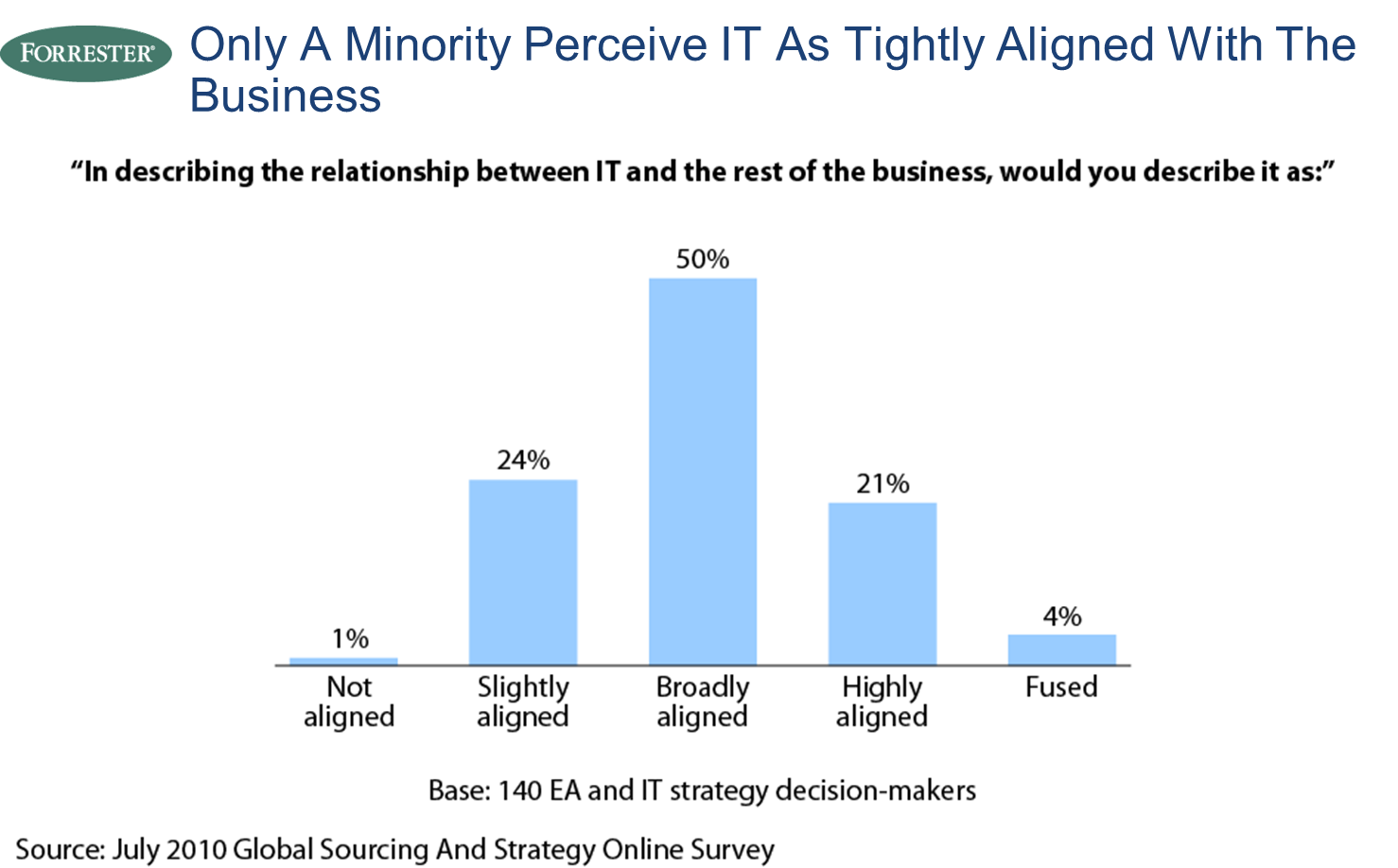
  • Only 4% said that Business and IT were fused together

 These challenges require a shift to a modern IT (process based)

  1. A “changed” IT organization
  2. An effective understanding of key business services and how IT supports them
  3. Managing the IT supply chain as a service catalyst
  4. Adoption of best practice framework(s) 

 Recommendations

  1. Think service from the outside in.  Is your service desk a service catalyst?
  2. Look at how you work with your Development Team – what is the communication, how could that be improved?
  3. Evaluate your change management process end-to-end.  Is there an opportunity for improvement?
  4. Reboot Service Management

 The stand out quote for me was – “ITIL is not a religion, don’t be a religious fan”

Sharyn Leaver – Vice President serving EA Professionals

It is easy to register to Forrsights – here is the LINK

Leave a comment

Filed under Business

If CIOs are not Business Leaders are they Change Agents and Innovators?

In recent posts I have been banging the drum about how COBIT 5 provides Business Executives and Technology Leadership with a common language to drive the Business forward in a joined-up way. 

So the article below, which appeared on CIO.com on Friday 18th May, made me sit up and take notice.


Bernard Golden is CEO of consulting firm HyperStratus, which specializes in virtualization, cloud computing and related issues. He is also the author of “Virtualization for Dummies,” the best-selling book on virtualization to date

CIOs Don’t Need to Be Business Leaders – LINK

“Given the complexity of today’s applications, it’s folly to suggest that the future role of the CIO is less technical and more businesslike, columnist Bernard Golden writes. If anything, it’s the opposite — the business side of the enterprise should embrace technology.”

Notion of CIO as Business Leader Just Plain Wrong

You Can’t Discuss Tech Without Knowing Tech

In Today’s Economy, CIOs Obligated to Know Tech

“Frankly, that issue of talking to the CEO in business language with which he or she is comfortable is a red herring. The fact is, businesses today are technology businesses. Information technology is core to what they do.”

Please find below two real world examples of the CIO as the driving force for Transformational Change and how Innovation is taking Systems of Engagement to another level.

IT transformation drives the business forward

Mike Wolfe – Senior Vice President and CIO @AMD

IT Transformation is a bit of a slippery term

Typically IT spends 70% of the budget on keeping the lights on which is not acceptable as the CEO gets 30 cents back on each dollar of their investment

Blank sheet innovation, doing things radically different is difficult for people to do

03:20 – You have to get to the place where a very complex topic can be stated very simply in a way that it applies to everyone in the company.  For our Business Leaders it has to be about how does this impact the company, they don’t care about the technology frankly.  They just want to know how it is moving the bottom line forward – more sales, more profitability, less cost.

Philip Clarke at Tesco is one of the few CIOs (Group IT Director) who have made it to the top job.  He became CEO in March 2011 and made the following statement at the annual results presentation in April 2012.

“I’m announcing today our 1 billion pounds plan to put the heart and soul back into Tesco,” Chief Executive Phil Clarke told reporters after the group reported a small full-year profit rise that met market expectations.

“The plan isn’t radical, isn’t a radical change of direction, but it’s a radical change of pace,” he said.

From ‘Broccoli Cam’ to electronic shelf edge labels, Chief Information Officer Mike McNamara shows us around the latest technology innovations in store, as well as a short preview of technology currently being worked on in the labs.

This video clip showcases hand scanners to staff badge sized computers.  The convergence of physical and online is best shown when you buy the DVD physical product and the film is available to view online in the customers Blink Box Digital Locker.

Labs are working on bringing to life an Augmented Reality application that enables a smartphone to take a flat image and give it three dimensions, e.g. providing serving suggestions for the customer.   

In my view, any successful CIO has to demystify the Technology and show how transformational change will deliver value to the Business.

I keep repeating the same mantra that any Technology capability only exists to serve the Business.

Its not about the CIO being an expert in either Business or Technology it is about the CIO having a foot in both camps.

Tesco will bounce back because the Company has invested heavily in accelerating change by delivering innovation in-store.  The CEO “gets it” and is sure to provide full support for the CIO.


 Creativity is thinking up new things. Innovation is doing new things.

Theodore Levitt

Leave a comment

Filed under Business

COBIT 5 is the Lingua Franca for Business Executives and Technology Leadership

Introducing COBIT 5

COBIT 5 is designed to serve both the needs of Business Executives and IT Professionals

IT is getting more complex every day but IT Governance doesn’t have to.

5 Essential Facts= LINK

Fact Number 2

“COBIT 5 is the only business framework for the governance and management of enterprise IT.

COBIT’s globally accepted principles, practices, analytical tools and models are designed for business executives – not just IT leaders. What’s more, COBIT 5 can be used in any industry and by organizations of all sizes”.

COBIT 5 – Govern and Manage Enterprise IT

ISACA International President Ken Vander Wal discusses the 5 Principles of COBIT 5 and how the framework helps Govern and Manage Enterprise IT.

COBIT 5 – Observations

Specialists are very good at what they do,” he said. “Service management professionals manage and, for most, their preferred guidance is ITIL. Security professionals protect, and, for many of them, the preferred guidance is the ISO/IEC 27000 series.

By using a COBIT-inspired model, all groups were able to see how their work fit under an overall umbrella and how their work related to each other’s work.”

Bob Frelinger, manager of the Process Management program for Oracle’s Global IT group

Here is a smart tweet from Greg and an interesting comment from Mr TIPU.

“The difference between COBIT and ITIL is that a COBIT practitioner knows the difference”.

Gregory Tucker ‏@ITSMinfo on Thursday !0th May

“Was asked if I could do an #ITIL assessment. No, I’d use ##COBIT. Surprised look: he hadn’t thought of that.”

Rob England ‏@theitskeptic on Wednesday 16th May

What’s in COBIT 5 for Auditors? – LINK

Shifts from a Technology to a Business Conversation

COBIT 5: Avoiding Common Implementation Missteps

Brian Barnier (Video Clip)LINK

So we are one month on since the launch of  COBIT 5 and there have been more than 66,000 publication downloads.

Practitioners have  warmed to the new Evaluate, Direct and Monitor processes for the Governance of Enterprise IT.

ISACA is turning it’s attention to COBIT 5 Training,

For more information or a list of dates and locations please contact COBITtraining@isaca.org.

For too long there has been a disconnect between Business and Technology goals.

COBIT 5  is a common language to strengthen the interlock between Business Executives and Technology leadership.

When there’s a downpour in IT you need the COBIT 5 umbrella framework.

“If management is about running the business, governance is about seeing that it is run properly.” – R Tricker


1 Comment

Filed under Business

What are the Service Expectations of the Net Generation?

“They are variously known as the Net Generation, Millennials, Generation Y or Digital Natives. But whatever you call this group of young people—roughly, those born between 1980 and 2000—there is a widespread consensus among educators, marketers and policymakers that digital technologies have given rise to a new generation of students, consumers, and citizens who see the world in a different way. Growing up with the internet, it is argued, has transformed their approach to education, work and politics.”

Economist, ‘The net generation, unplugged’

Don Tapscott

Don is an authority on business strategy and the chairman of nGenera Insight.

He first coined the term Net Generation

I implore you to watch the first 10 minutes of this interview

This is the first generation to be bathed in bits

This generation has better active memory and switching ability

The internet is eating the neo-cortex of youth today

The internet Is not the problem, it’s like blaming the library for ignorance

There is a danger that we will leave a trail of digital crumbs as we go through life

Previously Big Brother (Governmenet) and Little Brother (Corporations) controlled information dissemination, however Baby Brother (Net Generation) is where you have all these people wilfully giving away all this information about themselves.

Dave Chalmers

Dave Chalmers from HP discussing the rise of the digital native and its impact

We are seeing fundamental shifts in how organisations are having to adapt to meet the demands of the workforce that is coming towards them

Their attitude to information and sharing is fundamentally different

Why shouldn’t corporate data be shared

Jim Stikeleather

Chief Innovation Officer for Dell Services

Are your digital natives restless?

New generation of workers, these are the digital natives they come better equipped and more knowlegable than maybe your own IT organsisation they have high expectations of information being available anytime anyplace.

Don Tapscott

Please watch the first 3 minutes of this clip

Best Buy CEO – “give people a license to self-organise to create value”

The most important people in the company are the Blue Shirts who are closest to the customer

25.000 workers have created a social network called “Blue Shirt Nation” where staff use these new tools for collaboration to share and resolve problems

You shouldn’t focus on your customers you should engage them

So how will the Net Generation choose to interact with your company and what are their Service Expectations?

Typically, the front door to any organisation providing services has either been via the contact centre, website, self-service portal or email. 

The fundamental difference now is that the Net Generation will look to forums, social and business networks for access to instant information.  They are less disposed to wait for a slower response from a process-bound service provider.

The increasing use of communication backchannels (Twitter @companyhelpname or #hashtag) means that service providers must now actively listen to the chatterati and be pro-active in sensing and responding to Net Generation real-time feedback.

At Best Buy the “Blue Shirt Nation” social network of 25,000 customer facing staff has amassed a tremendous body of tacit knowledge about resolution of known issues and errors which are stored in the cloud and not readily available to the service organisation.  

Looking forward, it is not clear if there is still a requirement to bear the cost of a passive, re-active global Level 1 service desk when internal employees and customers are finding their own solutions across Business Units and outside of company boundaries.

So, put yourself in the shoes of your Net Generation employees / consumers.  It is important to recognise that their expectation of access to information and collaboration is fundamentally different.  You must address their requirement for new interactions by designing next generation services. 

Recruit savvy Net Generation individuals to help re-invent the service ecosystem so that there is more transparency and moments of engagement at the organisations perimeter.  In achieving this aim it should be possible to improve the overall service experience.  That is the least the Net Generation expect and if this utility is not delivered then Net Generation consumers will be lost to you and go elsewhere.

The old believe everything, the middle age suspect everything and the young know everything


(Oscar Wilde)

1 Comment

Filed under Business